
Thank you from WorkUP

Thank you from WorkUP
As 2025 comes to an end, I want to say a heartfelt thank you.
Thank you for choosing to show up.
Thank you for the way you’ve engaged with us throughout the year.
Thank you for the work you do with us and far beyond us – for believing things can change, and for the steady, determined work you do to turn that belief into reality.
Our work is richer and genuinely better because of our connection with you.
I’d also like to reflect on some of the highlights of our work together this year, many of which are helping set us up for another strong year of capacity and capability building across our critically important sector.
As always, we delivered our workforce survey but this year we expanded it, taking a deeper look into burnout and worker wellbeing. We used the World Health Organisation definition, which describes burnout as a combination of three elements:
- Energy depletion or exhaustion
- Increased mental distance/cynicism towards the work and job
- Reduced professional efficacy or sense of accomplishment.
Experiencing all three is what classifies a person as experiencing burnout.
One thing the survey told us: cynicism across the sector is low.
Given the challenges and frustrations that workers face every day, high cynicism might have been expected but instead, we saw the opposite. Over and over again, we’ve seen examples this year of people choosing not to lose hope. This isn’t passive acceptance of the status quo – it’s active commitment to change.
Throughout 2025, WorkUP delivered projects, resources, workshops, scholarships and grants that reflect this shared commitment to building safer communities.
We delivered a range of workshops supporting workers to build a deep understanding of coercive control in readiness for the new legislation. These workshops were followed by a Roundtable that brought the sector together to explore strengths, identify areas of concern and consider ways to address or minimise these.
Our Beyond Awareness workshops invited participants to deepen their understanding of our shared past with a focus on the histories and lived experiences of First Nations peoples and what this means for our practice, and how we show up in our work, services and communities.
Reflective practice has also been a strong thread this year. Our Reflective Practice Toolkit grew from insights shared in workshops exploring the Workforce Capability Framework. The uptake of this toolkit shows just how committed the workforce is to growth and development as practitioners and leaders.
The facilitator of our Allies in Advocacy program described the recent delivery as one of the most inspiring experiences of their career. Leaders from across the sector have committed to an 18-month journey to create meaningful change and strengthen systems and processes.
And of course, the sector continued to engage deeply with the Dare to Lead program, a clear demonstration of the courage and willingness to look inward to build leadership capacity.
As we move into 2026, WorkUP will be finalising our Strategic Workforce Plan through to 2027.
Thank you to everyone who has participated in workshops so far, shared their challenges openly and helped explore new possibilities as we co-create a powerful plan to guide our work together.
We look forward to sharing this with you, and deepening our collective insight at the Courageous, Connected, Capable Symposium on in Brisbane on 18 March – Register here.
Best wishes from Louise, and all of the WorkUP Team, for a safe and relaxing holiday season.

Emerging Practitioners Lead the Way: Celebrating Nine Months of Learning, Growth and Connection

Emerging Practitioners Lead the Way: Celebrating Nine Months of Learning, Growth and Connection
After nine months of learning, reflection, and connection, WorkUP Queensland’s Emerging Practitioner Pilot has officially wrapped up, marking an inspiring milestone for new practitioners and their services. The program supports emerging practitioners within our sector, to ensure they have solid start to their careers.
Over the course of the pilot, participants explored the depth, complexity, and humanity of domestic and family violence (DFV) work through more than 45 hours of discussion, reflection, and practice. Together, they engaged in over 20 workshops and communities of practice, guided by five guest facilitators who brought deep sector experience and wisdom to each session.
A community of practitioners, built on courage and curiosity
The pilot fostered a supportive environment where emerging practitioners could share openly, reflect deeply, and grow together. Facilitators described the group as one that consistently showed genuine curiosity, courage to bring it, and a willingness to engage.
“The WorkUp sessions provided me with the time and space I needed to understand, process, and reflect on my new professional journey. It was a wonderful opportunity to learn in a safe and supportive environment, connect with others in the sector, and explore how different practitioners approach their work.” – Pilot Participant
Celebrating collective achievement
Across the nine months, the cohort built knowledge and relationships that will carry forward into their daily practice and working lives. Practitioners reflected on how valuable it was to connect across services and regions, learning from one another while reaffirming the shared purpose of the sector’s work.
“There is incredible power in learning within a group space. It is inspiring to connect with like-minded people, as it fosters a sense of belonging and reassurance that you are on the right path. Yet, there is also great value in engaging with those who hold different perspectives.” – Pilot Participant
Looking ahead
The Emerging Practitioner Pilot has provided a strong foundation for how our sector can nurture and sustain its future workforce. The pilot is now being evaluated by the Queensland Centre for Domestic and Family Violence Research. Findings will inform how WorkUP and its partners can refine and strengthen the model to meet the evolving needs of practitioners and services across Queensland.
We extend a heartfelt thanks to all who took part — the emerging practitioners, managers, facilitators, and partner organisations who helped bring this pilot to life. Together, you’ve demonstrated the power of learning communities to build capability, connection, and hope for the future of the DFV workforce.
How Collaborative Grants Drove Impact Across Queensland
How Collaborative Grants Drove Impact Across Queensland
In 2025, Collaborative Grants have fueled remarkable sector-wide impact, with initiatives born from simple conversations, now transforming practice and strengthening responses to domestic and family violence across Queensland.
This year saw a DVNQ conference deepen networks and improve referral pathways, while the Remote Indigenous Women’s Shelter Network, made up of 14 organisations across Far North Queensland, Cape York and the Torres Strait, gathered for its first ever face-to-face leadership forum in 20 years. SPEAQ delivered a two-day statewide gathering focused on men’s behaviour change practice, creating vital space for practitioner dialogue.
BRISSC’s Pathways to Healing training centered First Nations women’s experiences, strengthening culturally responsive and trauma-informed practice. DVPC hosted a major two-day conference uniting the sector around victim-centered approaches, reforms and emerging challenges.
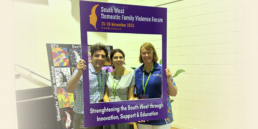
Meanwhile, the South West Domestic and Family Violence Forum boosted inter-agency collaboration in rural and remote communities, ensuring a more connected, capable workforce equipped to create lasting change for those impacted by violence.
While WorkUP’s Collaborative Grants have been highly valued, we are pausing the program while we review and strengthen our distribution process for the 2026–2027 financial year. We’ll share updates as soon as changes are confirmed and the program is ready to reopen in 2026. In the meantime, keep those creative ideas bubbling and stay tuned to our social media channels for announcements.
We would like to thank all of those who collaborated through local, regional and statewide workforce projects.
South West DFV Forum 2025 in Charleville
South West DFV Forum 2025 in Charleville
The powerful impact of our rural and remote communities coming together.
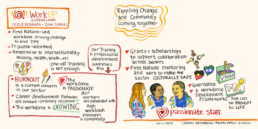
Our stakeholders continue to lead the way, bringing communities and workforces together to end violence in Queensland. A massive congratulations to the South West Domestic and Family Violence Forum working group and partners for staging such a successful forum, held over the 24-26 November in Charleville.
This event, run and organised by committed stakeholders, leaders and community members, brought all parts of the integrated service system together to share knowledge and collaborate to address the unique challenges facing rural and remote communities.
We heard courageous and powerful stories of lived experience and showcasing “good” practice from local services, along with statewide and national perspectives. A central theme of the forum was the power of communities and relationships in keeping women and children safe.
“Systems work when relationships work, responses become stronger and far more human.” – forum participant
WorkUP was excited to speak at the forum, sharing who we are, our work and the insights from the recently released 2025 workforce survey. Our survey tells a compelling story of workforce pain points, strengths, and hope. The audience engaged with some fresh perspectives on the risk of workforce burnout and emerging protective factors. This core message was relevant for all, no matter what sector they worked in.
WorkUP continues to lead and represent our workforce strongly, helping to increase the visibility and profile of our specialist sector across regional and remote areas, highlighting our workforce’s critical role as a powerful driver of change in ending violence. It was a privilege for members of the WorkUP team to be part of this important event.
Jobs Awareness Toolkit Consultation

Jobs Awareness Toolkit Consultation
One of the key goals of our Grow the Workforce strategy is to help the sector attract and retain talented, capable, and values-aligned people. Our recent workforce survey and workforce planning consultations have reinforced how important this is, especially as the sector continues to grow and as we work towards building a workforce that reflects the diverse communities we serve.
We’re excited to share that we’re in the early stages of developing a new Jobs Awareness Toolkit!
The toolkit aims to support the sector with some long-standing and evolving workforce challenges. It will provide a suite of resources designed to make the roles in our sector more visible to current tertiary students, new and recent graduates, and skilled workers looking to bring their transferable experience and shared values into this field.
To shape the key messages for promoting careers in our sector, we’ve drawn on existing WorkUP Queensland resources that highlight the wisdom and insights of the sector. We refined these with our Reference Group.
Our key messages are:
- The work is rewarding and meaningful.
- There are diverse pathways into the sector.
- Lived experience, diverse backgrounds, and cultural wisdom are valued.
- There are unique opportunities in rural and remote areas.
- Values, human rights, and social justice are central to the work.
- There is a strong focus on advocacy, activism, and systemic change.
- The sector encourages ongoing learning, growth, and connection.
- Workplaces are inclusive, affirming, and non-judgmental.
We welcome further feedback on the key messages and proposed resources. We are holding online consultation sessions January 19th and January 22nd, so register to share your thoughts and insights.
As part of this project, we’re creating a video series including eight videos aligned with each key message. We would love the sector’s involvement. This could look like:
- filming some footage at your service
- participating in a professionally recorded interview, or
- if you’d rather stay off camera, sharing your thoughts in writing so an actor can represent your perspective.
If you’d like to contribute to the videos and help build this important resource to raise visibility of our amazing sector and the work you do, please get in touch with christine@healingfoundation.org.au. We’d love to chat about what might work best for you.
When there is no time to reflect, it’s time to reflect

When there is no time to reflect, it’s time to reflect
Over the past few weeks, WorkUP has explored using the Reflective Practice Toolkit with workers from across Queensland. We hosted online workshops for allied support workers, practitioners, advanced practitioners and leaders. The conversations were rich, engaging and insightful.
Across the sessions, we trialed several reflective practice approaches including Scaling, the Head, Heart, Hand method and Feminist Practice Reflection to explore prompts from the toolkit cards. Jan Ungerer facilitated each session, encouraging participants to be creative and to use the resources in ways that suit their needs. It was inspiring to hear the many ways people already engage in reflective practice, from drawing to poetry. The toolkit offers another practical resource to add to these personal approaches.
One message that came through strongly was the sector’s clear understanding of the value of reflective practice both for individual wellbeing and for the quality of support provided to others. Finding time can be challenging, but as one participant wisely put it, “when there is no time to reflect, it’s time to reflect.”
Participants also shared ideas for building momentum with the Reflective Practice Toolkit. Suggestions included keeping it visible and accessible in the workspace, using it during team meetings, and integrating it into professional supervision. We’re looking forward to hearing how you’re using it and sharing your ideas across the sector.
We also experimented with using the toolkit to reflect on the workforce scenarios included in the Workforce Capability Framework implementation tips, which you can find here.
As the year ends, we’d like to share a short series of reflective questions from Amy Wormwell, one of the contributors to the Reflective Practice Toolkit and a strong advocate for reflective, self-aware practice:
- In what ways have I grown this year?
- What has been my greatest challenge?
- What has been my greatest achievement?
- Next year I would like to be more… by doing more…
- The learnings I take with me from 2025 are…
- To build my self-awareness and reflective practice in the coming year, I will…
You can find the Reflective Practice Toolkit here and please reach out to us if you have any questions or would like support with implementation.